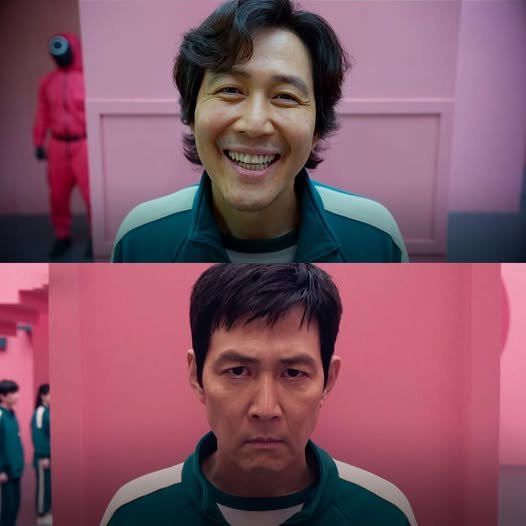
Seong Gi-hun character development is one of the central elements of Squid Game. Played by Lee Jung-jae, Gi-hun begins the series as a financially struggling gambler who makes poor decisions but still shows compassion toward other people. His journey through the deadly games changes almost every part of his personality. By the end of the series, he has gone from a desperate man trying to solve his personal problems to someone willing to sacrifice himself for another person.
Gi-hun’s transformation is not simple. He becomes stronger and more determined, but his experiences also leave him traumatized, angry, and emotionally exhausted. Across three seasons, his story explores guilt, humanity, responsibility, sacrifice, and the consequences of trying to resist a system built around exploitation.
Gi-hun Before the Squid Game
When viewers first meet Gi-hun, he is struggling with money, gambling, and his personal life. He is divorced and wants to maintain a relationship with his young daughter, but his financial problems make his situation increasingly difficult. Netflix describes him as a struggling gambler who enters the competition hoping to secure enough money to deal with his problems and improve his relationship with his daughter.
Gi-hun is not introduced as a conventional hero. He can be irresponsible, impulsive, and selfish. His gambling creates additional problems, and his decisions often hurt the people around him. However, he also possesses an important quality that becomes central to his character development: empathy.
His willingness to help others becomes particularly important once he enters the Squid Game. Even when surrounded by desperate contestants, Gi-hun repeatedly forms emotional connections with other players.
Season 1: From Self-Interest to Empathy
At the beginning of Season 1, Gi-hun primarily wants money. His motivation is personal and practical. He wants to escape debt and improve his circumstances.
The games gradually change his priorities.
As contestants are eliminated, Gi-hun witnesses the horrifying consequences of the competition. Instead of becoming completely numb to the violence, he becomes increasingly concerned about the people around him.
His relationships with players such as Cho Sang-woo, Kang Sae-byeok, and Oh Il-nam reveal different aspects of his personality. He develops trust and emotional connections even though everyone is technically competing against everyone else.
This is an important stage in Seong Gi-hun character development because the competition forces him to choose between survival and humanity.
Gi-hun eventually wins the competition and receives the massive prize. On paper, this should solve his problems. Instead, the experience leaves him emotionally damaged. Winning does not erase the memories of everyone who died.
Netflix describes Gi-hun as experiencing severe survivor’s remorse after winning the original competition.
His transformation is therefore not simply about becoming stronger. It is about realizing that surviving does not necessarily mean escaping the consequences of what happened.
The Red Hair and a New Gi-hun
One of the clearest visual signs of Gi-hun’s transformation after Season 1 is his red hair.
Director Hwang Dong-hyuk explained that Gi-hun undergoes a fundamental change after his experience in the first competition. His new appearance represents the fact that he is no longer the same person viewers met at the beginning of the story.
Gi-hun still has the money, but he cannot simply return to his old life.
He becomes increasingly obsessed with the Squid Game and the people responsible for organizing it. His decision to confront the system demonstrates how far his motivations have changed.
The man who originally entered the competition for money now wants to understand and challenge the organization that destroyed so many lives.
Season 2: Gi-hun Returns With a Purpose
Season 2 shows perhaps the biggest shift in Gi-hun’s personality.
He voluntarily returns to the Squid Game instead of entering because he needs money. His objective is connected to stopping the competition and confronting those behind it.
Netflix’s coverage of Season 2 emphasizes the contrast between the Gi-hun seen in Season 1 and the character returning in Season 2. Hwang Dong-hyuk explained that something inside Gi-hun had been broken by everything he experienced, while Lee Jung-jae discussed how different Gi-hun’s state of mind had become.
This difference changes the way Gi-hun approaches the games.
In Season 1, he is largely reacting to circumstances. In Season 2, he enters with knowledge.
He knows the rules. He understands how dangerous the games are. He knows that the people behind them are capable of manipulating the contestants.
That knowledge gives him a different kind of confidence.
However, it also creates a new problem: Gi-hun becomes increasingly focused on his mission.
Gi-hun’s Conscience
Although Gi-hun becomes darker in Season 2, his compassion does not completely disappear.
Lee Jung-jae explained that conscience was an important part of his approach to the character. The actor wanted to preserve the goodness that existed within Gi-hun during the first season while showing how his experiences had changed him.
This creates an important contradiction.
Gi-hun wants to destroy the Squid Game, but he is forced to operate inside the very environment he wants to eliminate.
He must make decisions that affect other players while dealing with people who have completely different motivations.
The result is a character who is more determined than before but also more emotionally unstable.
The Failed Rebellion
Gi-hun’s attempt to fight back against the organization becomes a major turning point.
His rebellion fails, and the consequences are devastating. His close friend Jung-bae is killed, leaving Gi-hun devastated.
By the end of Season 2, Gi-hun is physically and emotionally broken. Netflix describes him as being at his lowest point after the failed rebellion and Jung-bae’s death.
This failure is important because it challenges Gi-hun’s belief that determination alone can change the system.
He entered Season 2 believing he could use his knowledge of the games to fight back. Instead, the system proves capable of adapting to his resistance.
His confidence is replaced by grief.
Season 3: Gi-hun at His Lowest Point
Season 3 continues directly from Gi-hun’s emotional collapse.
The creator described the final season as focusing on Gi-hun’s transformation and how he responds to the challenges placed in front of him.
At this stage, Gi-hun is no longer the cheerful and sometimes foolish man from Season 1.
He has lost friends, experienced betrayal, and failed to stop the competition.
His motivation remains connected to ending the Squid Game, but his emotional condition becomes much darker.
Netflix’s character guide explains that Gi-hun remains determined to take down the game even after his failed rebellion, while his allies help remind him of his conscience and kindness.
This is significant because Gi-hun’s final struggle is not only against the people running the games.
It is also against himself.
Gi-hun Reaches His Breaking Point
One of the most important moments in his Season 3 development occurs when his anger leads him to kill Dae-ho.
Until this point, Gi-hun had generally avoided killing another contestant himself. His anger toward Dae-ho becomes overwhelming after the failed rebellion and Jung-bae’s death.
Netflix describes this moment as Gi-hun reaching his “rock bottom.” Hwang explained that Gi-hun redirects his guilt and blames Dae-ho for the deaths that followed the failed uprising.
This moment shows how far Gi-hun has fallen.
The compassionate survivor from Season 1 is capable of violence against another player. His moral struggle has become much more complicated.
However, this does not mean his humanity has completely disappeared.
Instead, the story uses this low point to make his later decisions more meaningful.
The Conflict With the Front Man
Gi-hun’s relationship with the Front Man becomes one of the most important parts of his character arc.
The two characters represent opposing views about human nature.
Gi-hun continues to believe that people can choose compassion even under terrible circumstances. The Front Man increasingly views the players through a cynical perspective.
Their conflict therefore becomes more than a physical battle.
It becomes a conflict over whether people are fundamentally capable of maintaining their humanity when placed under extreme pressure.
The Front Man attempts to destroy Gi-hun’s belief in humanity. Netflix describes their Season 3 conflict as a psychological and moral battle over Gi-hun’s convictions.
This makes Gi-hun’s final decisions especially important.
Gi-hun’s Final Transformation
By the conclusion of the series, Gi-hun’s development reaches its final stage.
He ultimately sacrifices himself to protect Jun-hee’s baby. Netflix’s explanation of the finale identifies Gi-hun’s sacrifice as the conclusion of his journey and connects it to his rediscovered humanity and conscience.
This decision completes the transformation that began in Season 1.
At the beginning of the story, Gi-hun enters the game because he wants money.
By the end, he gives up his own life so another person can have a chance to live.
That contrast is the foundation of his character arc.
From Survivor to Protector
Gi-hun’s journey can be understood through several stages:
| Stage | Gi-hun’s Main Motivation |
|---|---|
| Before the games | Money and personal survival |
| Season 1 | Survival and helping others |
| After Season 1 | Guilt and understanding the game |
| Season 2 | Stopping the Squid Game |
| Failed rebellion | Fighting back despite personal loss |
| Season 3 | Ending the system while struggling with despair |
| Finale | Protecting another life through sacrifice |
This progression shows why Gi-hun is more complicated than a traditional hero.
He does not simply become stronger with every season.
Sometimes he becomes weaker.
Sometimes he makes worse decisions.
Sometimes he loses control.
But each experience forces him to reconsider what kind of person he wants to be.
The Importance of Humanity
The central idea behind Seong Gi-hun character development is humanity.
The Squid Game is designed to reduce people to numbers and contestants. Players become competitors, and survival becomes more important than relationships.
Gi-hun repeatedly challenges that idea.
His friendships, guilt, compassion, anger, and eventual sacrifice demonstrate that he refuses to see human life as merely another part of the game.
Even after experiencing betrayal and extreme violence, he continues to struggle with the question of whether people can remain human under unbearable circumstances.
The final season makes this idea especially clear. Hwang Dong-hyuk explained that Gi-hun’s sacrifice was connected to the larger message that people cannot build a future by pursuing only immediate self-interest and refusing sacrifice or responsibility.
Conclusion
Seong Gi-hun character development is ultimately a journey from selfish survival to selfless sacrifice.
He begins as an irresponsible gambler struggling with debt and family problems. The first Squid Game forces him to confront death and develop empathy. Winning does not bring him peace because he carries the memories and guilt of the people who died.
In Season 2, Gi-hun returns with a completely different purpose. He is no longer interested primarily in the prize money. He wants to stop the organization responsible for the games. His failed rebellion and Jung-bae’s death push him into deeper despair.
Season 3 takes that transformation even further. Gi-hun reaches a moral low point, struggles with guilt and anger, and confronts the Front Man in a battle over human nature. Yet he ultimately rediscovers the compassion that defined him earlier in the story.
His final sacrifice completes the arc.
The man who once entered the Squid Game because he wanted to save himself eventually gives his life to protect someone else. Through Gi-hun, Squid Game presents a character whose greatest transformation is not becoming more powerful, but deciding that another person’s life is worth more than his own survival.
Leave a Reply