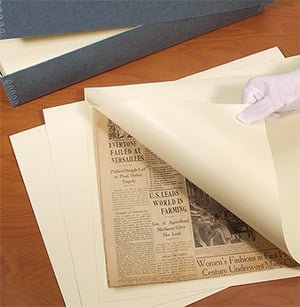
Newspapers are valuable historical records that capture important events, advertisements, photographs, opinions, and everyday life. However, preserving them can be challenging because traditional newsprint is often made from inexpensive wood-pulp paper that naturally becomes acidic, brittle, yellow, and fragile as it ages. Proper newspaper preservation techniques can significantly slow this deterioration and help protect newspapers for future generations.
Whether you are preserving a single historic newspaper, a family collection, or a large archive, the most effective approach involves appropriate storage, environmental control, careful handling, and digital or microfilm reproduction when necessary.
Why Newspapers Are Difficult to Preserve
Many newspapers produced from the mid-19th century onward were printed on machine-made wood-pulp paper. Unlike high-quality archival paper, this material was designed primarily to be inexpensive and practical rather than durable.
As the paper ages, chemical reactions can cause it to become acidic. Exposure to heat, humidity, light, and pollutants can accelerate this process. Eventually, the newspaper may turn yellow or brown, lose flexibility, and become so brittle that pages can tear or crumble during handling.
This is why preservation should ideally begin before serious deterioration occurs.
1. Store Newspapers in a Cool, Stable Environment
One of the most important newspaper preservation techniques is controlling the storage environment.
The Library of Congress recommends keeping newspapers in a cool, stable location, ideally at temperatures no higher than about 70°F (21°C), with relative humidity generally around 30–55%. The National Archives gives a narrower target of approximately 60–70°F and 40–50% relative humidity for important newspaper artifacts.
Avoid storing newspapers in:
- Attics
- Garages
- Damp basements
- Areas near radiators or heaters
- Locations with large temperature fluctuations
- Areas exposed to direct sunlight
High temperatures can accelerate chemical deterioration, while excessive humidity can encourage mold growth and physical distortion.
2. Protect Newspapers From Light
Light can cause serious damage to newsprint. Prolonged exposure may lead to yellowing, darkening, fading, and increased brittleness.
For long-term preservation, newspapers should therefore be kept away from direct sunlight and strong artificial light. If an important newspaper needs to be displayed, creating a high-quality reproduction is generally safer than displaying the original.
This approach allows people to view the content without exposing the original artifact to continuous light.
3. Use Archival Storage Materials
The materials surrounding a newspaper can influence its long-term condition. Acid-free, lignin-free, and preferably buffered paper and board are recommended for archival newspaper housing.
Newspapers can be placed in appropriately sized folders, boxes, or flat storage systems. Archival boxes provide physical protection while reducing exposure to environmental contaminants.
For larger collections, flat storage drawers can be particularly useful because they provide full support for oversized newspapers. Shelving should also be stable and large enough to properly support the boxes and materials.
4. Store Newspapers Flat
Full-sized newspapers should generally be stored flat rather than repeatedly folded. Folding creates stress along the same lines and can eventually cause the paper to crack or break.
The National Archives recommends storing newspapers flat inside protective folders or rigid boxes.
Collections should also be organized carefully, preferably in chronological order. Clearly labeling boxes with newspaper titles and date ranges can reduce unnecessary handling when researchers need to locate a particular issue.
5. Handle Newspapers Carefully
Careful handling is one of the simplest and most affordable preservation measures.
Before handling fragile newspapers, use clean hands and prepare a large, clean work surface. The surface should be large enough to fully support the opened newspaper. Food and drinks should be kept away from the workspace.
When turning pages, support the paper with your hands instead of pulling on corners or edges. Fragile newsprint can easily tear when unsupported.
Avoid:
- Folding corners
- Paper clips
- Staples
- Rubber bands
- Glue
- Adhesive tape
- Sticky notes
- Back-folding existing creases
If a newspaper is already folded, it is safer to follow its original fold rather than forcing it into the opposite direction.
6. Avoid DIY Repairs With Tape or Glue
A common mistake is repairing torn newspapers with ordinary household tape or glue. Although these materials may appear to fix a tear temporarily, they can create additional problems over time.
Pressure-sensitive tape and inappropriate adhesives can stain paper, become difficult to remove, and interfere with professional conservation treatments. The National Archives specifically advises against laminating newspapers or using pressure-sensitive mending tape on materials intended for preservation.
If a historically important newspaper has major tears, severe brittleness, or other structural problems, professional conservation is usually the safer option.
7. Consider Protective Sleeves for Clippings
Newspaper clippings can be particularly difficult to handle because their small size and brittle edges make them vulnerable to tearing.
Clear polyester, polypropylene, or polyethylene sleeves can provide additional protection for some clippings. However, plastic sleeves are not suitable for every situation because they can create static and do not provide the alkaline buffering offered by suitable archival paper materials.
Newspaper clippings should also be kept separate from photographs, letters, and other sensitive documents because newsprint can transfer acidic materials and cause staining.
8. Digitize Important Newspapers
Digitization has become an important part of modern newspaper preservation.
A high-quality digital scan can preserve access to the information contained in a newspaper while reducing the need to repeatedly handle the original. Digitization is especially useful for newspapers that are too fragile for frequent research use.
When digitizing a fragile newspaper, it should not be pushed through an automatic document feeder. The Library of Congress recommends supporting the newspaper properly and using an appropriate flat scanning or imaging setup.
Digital files should also have appropriate backups so that a single hard-drive failure does not eliminate the preservation copy.
9. Use Microfilm for Large Collections
Before widespread digital preservation, microfilming was an important method for preserving newspaper content.
Preservation microfilm can provide stable, long-term access to newspaper information when produced and stored according to appropriate archival standards. It has historically been particularly useful for large newspaper collections.
Many institutional preservation programs have also used microfilm as a source for later digitization. The Library of Congress continues to provide technical guidance for newspaper digitization programs.
10. Professional Conservation Treatment
Some newspapers become so fragile that ordinary storage and handling are no longer enough.
Professional paper conservators can evaluate problems such as severe brittleness, tears, distortion, staining, and acidity. Depending on the condition and importance of the newspaper, conservation treatment may involve specialized techniques designed to stabilize the paper or reduce the effects of acidity.
Such treatments should be considered carefully because conservation can be expensive, and different newspapers require different approaches.
11. Make Copies for Display
Historic newspapers should generally not be placed on permanent display in ordinary home or office environments.
Light exposure can accelerate deterioration, particularly with poor-quality newsprint. Instead, a high-quality color reproduction or printed digital copy can be displayed while the original remains safely stored.
This is particularly useful for newspapers featuring major historical events, family announcements, special editions, or other significant material.
12. Create an Organized Preservation System
Preservation is easier when a collection is properly organized.
For a larger newspaper collection, consider recording:
- Newspaper title
- Publication date
- Issue number
- Location of storage
- Condition
- Missing issues
- Digital-copy status
- Conservation history
Proper labeling reduces unnecessary handling and makes it easier to locate specific issues. The Library of Congress recommends labeling storage boxes with titles and date ranges and maintaining information about missing issues.
Common Newspaper Preservation Mistakes
Several seemingly helpful methods can actually damage newspapers over time. Common mistakes include storing newspapers in hot attics, exposing them to sunlight, folding them repeatedly, using household tape, placing them in poor-quality cardboard, and attempting aggressive repairs.
Another mistake is handling fragile newspapers more than necessary. Once a collection has been digitized or microfilmed, researchers can often use the reproduction rather than repeatedly handling the original.
Conclusion
Effective newspaper preservation techniques focus on preventing damage rather than trying to repair severely deteriorated paper later. Cool and stable environmental conditions, limited light exposure, archival storage materials, flat storage, and careful handling can significantly extend the useful life of newsprint.
For historically important or fragile newspapers, digitization and preservation microfilm can provide additional access while reducing physical handling. When a newspaper has severe damage, professional conservation is preferable to household repairs involving tape, glue, or lamination.
By combining appropriate storage with careful handling and modern reformatting methods, individuals, libraries, and archives can preserve both the physical newspaper and the valuable historical information it contains.
Leave a Reply