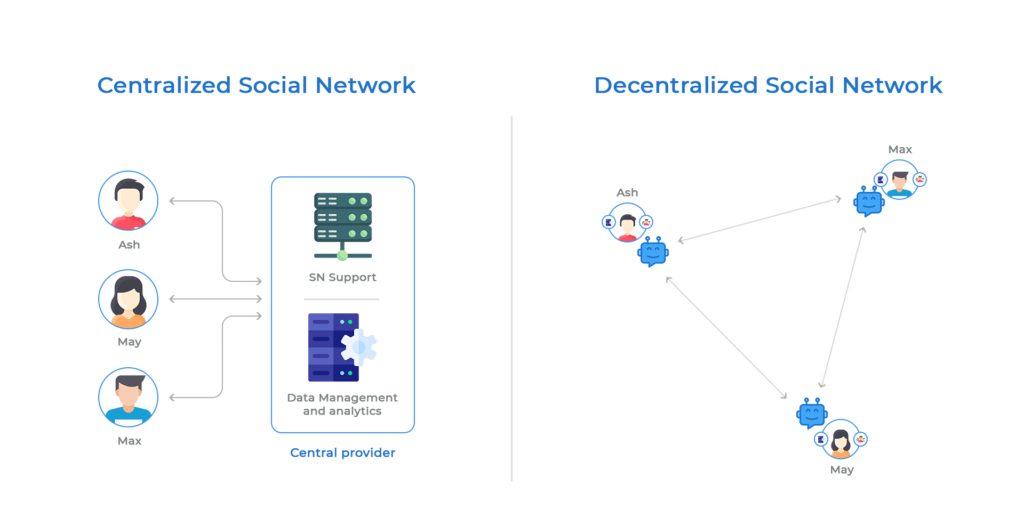
Decentralized social media protocols are open technologies that allow social networks to operate without relying entirely on one company or platform. Instead of keeping users, posts, identities, and social graphs inside a single application, these protocols distribute control across servers, relays, users, or blockchain infrastructure.
Major Decentralized Social Media Protocols
ActivityPub is a W3C-standardized protocol based on federation. Different independently operated servers can communicate with one another, allowing users on different services to interact. Mastodon is one of its best-known implementations.
AT Protocol is the protocol behind Bluesky. It focuses on portable identities, user repositories, interoperability, and allowing different services to participate in the same social ecosystem.
Nostr uses cryptographically signed events distributed through independent relays. A user’s identity is based on a cryptographic key pair, while relays handle the distribution and storage of social data.
Farcaster combines on-chain identity with off-chain social data. Its architecture uses cryptographic identities, signed messages, and a distributed server infrastructure to allow multiple applications to build on the same social network.
Lens Protocol takes a blockchain-oriented approach to social graphs, allowing developers to build applications around composable social identities and relationships.
Why These Protocols Matter
Traditional social networks generally combine the application, identity, social graph, content distribution, and moderation system into one platform. Decentralized protocols attempt to separate some of these components. This can make user identities, audiences, content, or social relationships more portable between applications.
However, decentralization does not mean every component is equally decentralized. Different protocols make different architectural trade-offs involving identity, storage, discovery, moderation, scalability, and usability.
For example, ActivityPub emphasizes federation, Nostr relies heavily on independent relays, AT Protocol uses a modular federated architecture, and Farcaster combines blockchain-based identity with distributed data infrastructure.
The Future of Decentralized Social Media
Research comparing these architectures suggests that there is no single design that solves every problem. Decentralized social systems still have to balance user sovereignty with usability, scalability, discovery, moderation, and interoperability.
As these protocols develop, social media may increasingly become a collection of interoperable applications built on shared infrastructure rather than one platform controlling the entire social graph.
Leave a Reply