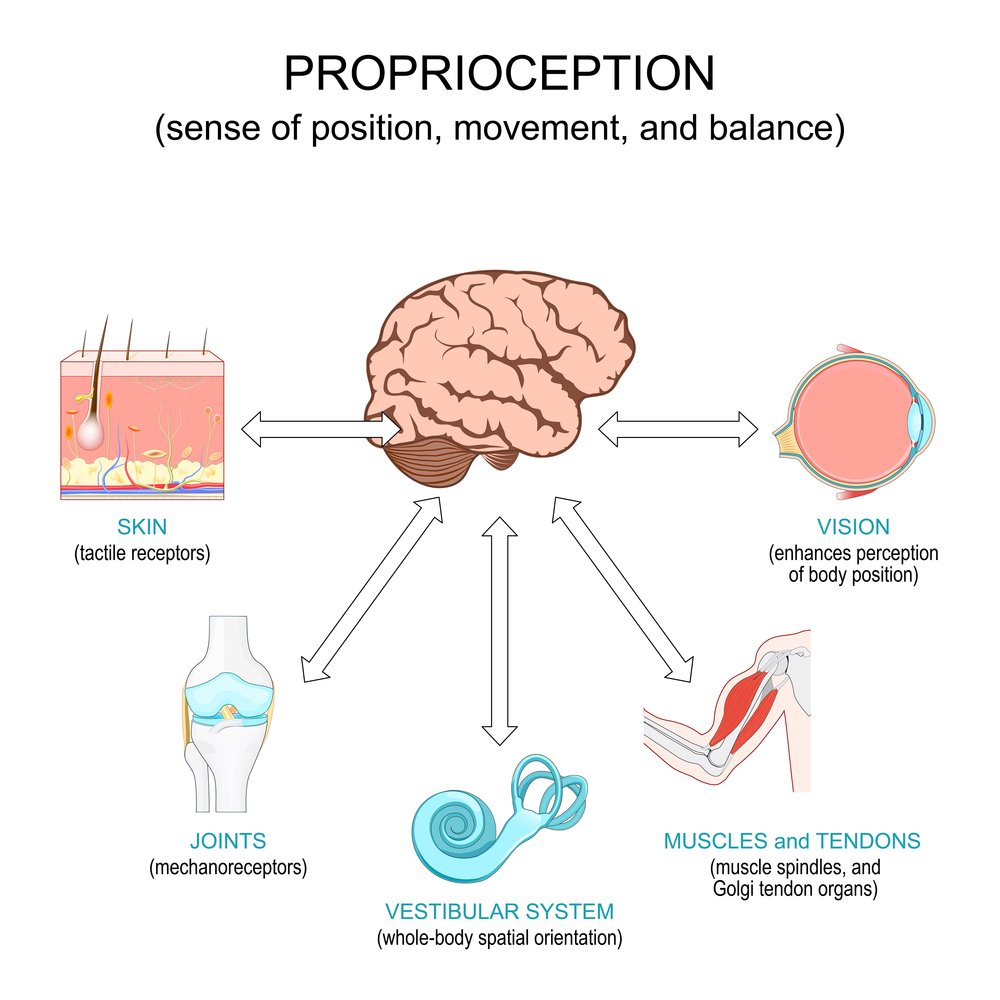
Proprioception exercises benefits include better balance, improved body awareness, greater movement control, and support for physical rehabilitation. Proprioception is the body’s ability to sense the position and movement of its joints and limbs without needing to look at them. This internal sense helps you walk, run, change direction, maintain posture, and perform everyday movements with greater control.
Exercises that challenge proprioception are commonly used in fitness, sports training, physical therapy, and rehabilitation. They may involve standing on one leg, walking on an uneven surface, performing controlled movements, or using balance equipment. Research suggests that proprioceptive and sensorimotor exercises can improve balance and functional performance, although the exact effects depend on the type of training and the person performing it.
What Is Proprioception?
Proprioception is sometimes described as the body’s internal sense of position. It allows the nervous system to receive information about where different parts of the body are located and how they are moving.
Specialized sensory receptors in muscles, tendons, joints, and other tissues provide information to the nervous system. The brain then combines this information with signals from vision and the vestibular system to help coordinate movement and maintain balance.
For example, you can close your eyes and touch your nose with your finger because your nervous system can estimate the position of your arm and hand without depending completely on your eyesight.
Good proprioception is useful during simple activities such as walking and climbing stairs, as well as more demanding activities such as sports, dancing, jumping, and changing direction quickly.
How Do Proprioception Exercises Work?
Proprioception exercises generally challenge the body to control position and movement under changing conditions.
A simple example is a single-leg stand. When you stand on one leg, your body continuously makes small adjustments to keep you upright. Your muscles, joints, vision, and nervous system work together to maintain stability.
Other exercises may reduce visual information, introduce unstable surfaces, or require controlled movement through different positions.
The goal is not simply to make an exercise difficult. Effective training should provide an appropriate challenge that encourages the nervous system and muscles to coordinate movement more accurately.
Proprioception Exercises Benefits for Balance
One of the most commonly discussed proprioception exercises benefits is improved balance.
Balance depends on information from several sensory systems. Proprioception contributes information about body and joint position, while vision and the vestibular system provide additional information about orientation and movement.
A 2024 systematic review and meta-analysis involving older adults found that sensorimotor and proprioceptive exercise programs improved several balance-related measures, including the Berg Balance Scale, Timed Up and Go test, functional reach, and single-leg stance. However, the researchers also rated the overall evidence from very low to low, meaning that more high-quality research is needed.
Exercises that challenge balance may therefore be useful for people who want to improve their ability to control their body during standing and movement.
Improved Body Awareness
Another important benefit is greater awareness of body position.
Proprioception helps you recognize where your limbs are without constantly looking at them. Training exercises can give the nervous system repeated opportunities to process information about joint angles, movement, and position.
For example, controlled lunges require awareness of foot placement, knee position, hip movement, and trunk alignment. Repeating the movement can help develop greater control over the positions involved.
However, it is important to distinguish general balance improvement from a direct improvement in proprioceptive perception. A recent systematic review found that exercises specifically designed to target particular proprioceptive functions produced more consistent improvements in direct measures of proprioception than broader programs that simply improved balance or strength.
Better Movement Control
Proprioception is closely connected with movement coordination.
When you move, your nervous system constantly receives information about what your body is doing. This information helps you make adjustments while the movement is happening.
For example, when walking over an uneven surface, your foot may land at a slightly different angle than expected. Your nervous system can detect the change and help your muscles respond.
Proprioception exercises can recreate some of these challenges in a controlled environment. Over time, this type of practice may help people become more comfortable controlling their body during movements that require balance and coordination.
Support for Sports Performance
Athletes frequently use balance and proprioceptive exercises as part of training and rehabilitation.
Sports such as football, basketball, tennis, volleyball, and martial arts involve frequent changes in direction, rapid stops, jumps, and single-leg movements. These activities require the body to respond quickly to changes in position.
Exercises such as single-leg balance, lateral lunges, controlled landing drills, and balance-board exercises can introduce movement challenges similar to those encountered during physical activity.
Proprioception training should not be considered a replacement for strength, conditioning, technique, or sport-specific training. Instead, it can be incorporated as one component of a broader training program.
Proprioception Exercises and Rehabilitation
Proprioceptive exercises are also used in rehabilitation programs.
After certain injuries or surgical procedures, a person may experience changes in balance, movement confidence, strength, or joint control. Rehabilitation professionals may use exercises that progressively challenge these abilities.
Research involving people undergoing hip or knee replacement has examined balance and proprioceptive training as part of rehabilitation. A 2025 systematic review and meta-analysis found that balance training was not consistently superior to conventional rehabilitation across a wide range of outcomes, although some measures showed improvement.
This highlights an important point: proprioceptive exercises can be useful, but they should generally be selected according to the individual’s condition, goals, and rehabilitation needs.
Common Proprioception Exercises
There are many ways to train proprioception. Some exercises require little or no equipment.
1. Single-Leg Stand
Stand upright and slowly lift one foot from the floor. Hold the position while maintaining control.
To make the exercise more challenging, you can gradually increase the duration or change the conditions under which you perform it. Beginners should perform balance exercises near a stable surface for support.
2. Heel-to-Toe Walking
Walk forward by placing the heel of one foot close to the toes of the opposite foot.
This exercise creates a narrow base of support and challenges balance and coordination.
3. Single-Leg Reach
Stand on one leg and slowly reach the other leg forward, backward, or sideways.
Keep the movement controlled rather than rushing through it.
4. Controlled Lunges
Lunges can challenge the body’s ability to control the hips, knees, ankles, and trunk.
Perform them slowly and focus on maintaining good alignment.
5. Balance Board Exercises
Balance boards and similar equipment can create an unstable surface. The body must continuously make small adjustments to remain balanced.
These exercises can be more difficult than basic balance drills and should be introduced gradually.
6. Step-Up Exercises
Step-ups require controlled movement of the legs while maintaining balance.
You can perform them on a stable step or platform at an appropriate height.
7. Uneven-Surface Walking
Walking on an appropriately safe uneven surface can challenge the sensory and motor systems involved in balance.
Research reviews have identified uneven-surface walking and other multisensory activities as components of proprioceptive or sensorimotor training programs.
Benefits for Older Adults
Proprioceptive and sensorimotor exercises can be particularly relevant for older adults because balance and sensory function can change with age.
The 2024 systematic review mentioned earlier found significant improvements in multiple balance measures following proprioceptive or sensorimotor exercise programs in older adults. However, the authors noted limitations in the quality and consistency of the evidence.
More recent research also continues to investigate multisensory exercise programs involving proprioceptive, visual, vestibular, and balance challenges. A 2025 scoping review found considerable variation in exercise design, frequency, intensity, and outcome measurements, making direct comparisons between studies difficult.
For older adults, exercises should therefore be selected according to current ability and performed in a safe environment.
Proprioception and Fall Prevention
Balance training is often included in programs designed to reduce fall risk.
Proprioception is only one part of fall prevention. Strength, vision, reaction time, gait, environmental hazards, medication effects, and other factors can also influence fall risk.
Some research on perturbation-based balance training has found improvements in balance control, mobility, gait speed, and other outcomes in older adults. However, perturbation training is a specific form of balance training and should not automatically be treated as equivalent to every type of proprioceptive exercise.
This distinction matters because different exercises train different physical and sensory abilities.
How Often Should You Do Proprioception Exercises?
There is no single schedule that works for everyone.
A beginner can start with short balance sessions several times per week. The difficulty can then be increased gradually as control improves.
Progression may involve:
- Increasing the duration of a balance exercise
- Adding controlled movement
- Reducing hand support
- Changing the base of support
- Adding a reaching task
- Introducing an appropriate unstable surface
- Combining balance with functional movements
The exercise should remain challenging without becoming uncontrolled or unsafe.
Safety Tips
Balance exercises can create a risk of falling if they are performed in an inappropriate environment.
Beginners should consider exercising near a sturdy support such as a countertop, rail, or stable piece of furniture. Clear the surrounding area of objects that could cause a trip.
Avoid progressing to difficult unstable-surface exercises before you can safely perform basic balance movements.
People recovering from an injury, surgery, neurological condition, or significant balance problem should discuss exercise selection with an appropriate healthcare or rehabilitation professional. Balance refers to the ability to maintain or regain body stability.
Balance uses information from proprioception, vision, and the vestibular system, along with muscular strength and nervous-system control.
This is why an exercise can improve balance without necessarily producing a measurable improvement in a specific aspect of proprioceptive perception. Recent research emphasizes that proprioceptive training is sometimes used as a broad label for exercises that actually involve several sensory and motor systems.
Who Can Benefit From Proprioception Exercises?
Different groups may incorporate proprioceptive exercises into their training or rehabilitation, including:
- Athletes
- Recreationally active adults
- Older adults
- People working on general balance
- Individuals recovering from certain injuries
- People participating in physical rehabilitation
The appropriate exercises depend on the person’s physical condition and goals.
For someone simply looking to improve general balance, basic single-leg exercises and controlled movement drills may be sufficient. Someone recovering from an injury may need a more structured progression designed by a physical therapist or other qualified professional.
Final Thoughts
The main proprioception exercises benefits involve improving the body’s ability to control position and movement. These exercises can support balance, coordination, body awareness, and functional movement when appropriately selected and progressed.
Research supports potential improvements in balance and functional measures, particularly among older adults, but the evidence is not uniform. Proprioception is also more specific than general balance, and exercises that directly target a particular proprioceptive ability may produce different results from broad balance-training programs.
A practical approach is to start with simple movements such as single-leg stands, controlled lunges, step-ups, and heel-to-toe walking. As ability improves, exercises can become more challenging through controlled changes in movement, support, or surface conditions.
For rehabilitation or significant balance difficulties, professional guidance can help ensure that exercises are appropriate and performed safely.
Leave a Reply