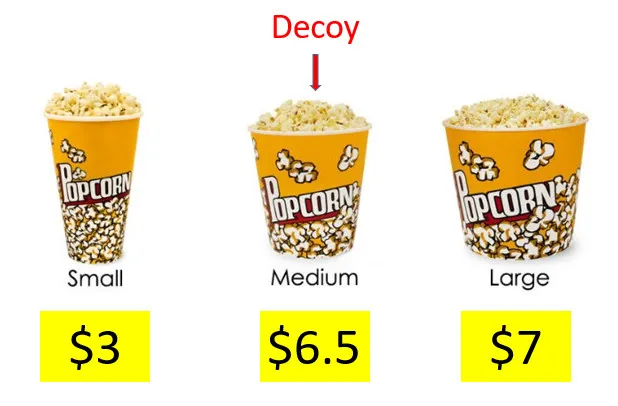
Decoy pricing strategy is a marketing technique that uses an additional pricing option to influence how customers compare products or services. Instead of simply offering two choices, a business introduces a third option that is deliberately less attractive than the option it wants customers to consider. This third option is called a decoy.
The strategy is closely related to the decoy effect, also known as the asymmetric dominance effect or attraction effect. Research shows that adding an inferior alternative can change how people evaluate the existing choices, sometimes increasing preference for the option that dominates the decoy.
Decoy pricing can be found in subscription plans, product packages, restaurant menus, retail offers, online stores, and other situations where customers must compare several alternatives.
What Is a Decoy Pricing Strategy?
A decoy pricing strategy involves creating three choices instead of two:
- Competitor: The alternative customers might naturally choose.
- Target: The option the business wants to make more attractive.
- Decoy: An inferior option designed to make the target look better by comparison.
The decoy is usually similar to the target but provides noticeably less value for a similar price.
For example, imagine a streaming service offers these plans:
| Plan | Monthly Price | Features |
|---|---|---|
| Basic | $8 | 5 features |
| Standard | $15 | 12 features |
| Premium | $16 | 20 features |
Here, the Standard plan could function as a decoy if the business wants customers to move toward Premium. The small price difference between Standard and Premium makes Premium appear more attractive in terms of features received for the additional cost.
The important element is not simply having a cheap, medium, and expensive product. The options need to be structured so that one option is clearly inferior to the target on relevant attributes.
How Does Decoy Pricing Work?
Decoy pricing changes the context in which customers evaluate choices.
Without a decoy, customers may compare two products directly. They might focus on price, quality, features, size, or another attribute.
When a carefully designed third option is introduced, customers gain another comparison point. The target may suddenly appear to offer stronger relative value.
Research on asymmetric dominance describes the decoy as an alternative that is inferior to the target but does not have the same relationship with the competitor.
For example:
- Option A: $10 for 5 features
- Option B: $20 for 15 features
- Option C: $19 for 8 features
Option C may make Option B appear significantly more attractive because customers can see that paying only slightly more provides considerably more features.
The customer’s decision has therefore been influenced by the relationship between the choices, rather than by looking at each product independently.
The Decoy Effect and Consumer Choice
The decoy effect has been studied extensively in consumer behavior and decision-making research. Early work examined how adding an asymmetrically dominated alternative could shift preferences between existing products.
A 2019 experimental study found that the asymmetric dominance effect could be replicated in risky-choice settings, although the effect depended on participants’ existing preferences. The researchers also found that adding another decoy did not necessarily make the effect stronger.
This is important because decoy pricing is not a guaranteed method for increasing sales. The design of the choices, customer preferences, and product category can all affect the outcome.
A Famous Example of Decoy Pricing
One frequently discussed example involves subscription pricing.
A classic illustration used three subscription choices:
- Web-only access for $59
- Print-only access for $125
- Print and web access for $125
The print-only option makes the combined print-and-web package look particularly attractive because customers receive more for the same price. Research discussing this example describes the print-only option as the decoy.
The example demonstrates an important principle of decoy pricing: the decoy does not necessarily need to be the cheapest option.
Its primary purpose is to create a comparison that makes another option easier to justify.
Decoy Pricing in Subscription Plans
Subscription businesses are particularly suitable for decoy pricing because they can adjust multiple attributes, including:
- Monthly price
- Storage
- Number of users
- Features
- Support
- Download limits
- Advertising
- Quality levels
- Usage limits
Consider a cloud-storage company offering:
| Plan | Storage | Price |
|---|---|---|
| Personal | 100 GB | $5 |
| Professional | 500 GB | $14 |
| Business | 1 TB | $15 |
The Professional plan can become less appealing when Business provides twice the storage for only $1 more.
Alternatively, a business might deliberately structure the middle option so that the highest option appears to offer considerably more value.
This type of comparison can encourage upselling, where customers move from a lower-priced product toward a more expensive package.
Research on competitive retailers has examined how businesses can use decoys to draw consumer attention toward alternatives with higher prices or different profitability characteristics.
Decoy Pricing in Restaurants
Restaurants can also use decoy pricing through menu design.
Suppose a restaurant offers:
- Regular burger — $8
- Premium burger — $14
- Large premium burger — $15
If the $14 option offers only modest improvements over the $8 option while the $15 option includes significantly more food or features, the highest-priced option may appear easier to justify.
Another example could involve beverages:
- Small — $3
- Medium — $5
- Large — $5.50
The medium option can make the large option appear more valuable because customers see a relatively small price difference for additional quantity.
Research has investigated priced-based decoys in restaurant menus and found that menu choices can be influenced by the introduction of a similar but inferior alternative.
Decoy Pricing in E-Commerce
Online stores have an advantage when using decoy pricing because they can display multiple options side by side.
A pricing page might show:
Starter — $9/month
5 projects
Professional — $19/month
20 projects
Business — $20/month
Unlimited projects
The comparison immediately highlights the difference between Professional and Business.
E-commerce companies can also experiment with different combinations of:
- Prices
- Product specifications
- Shipping options
- Bundles
- Features
- Warranty periods
- Service levels
Research has specifically examined decoy effects in online environments and found that the strength of the effect can vary depending on factors such as salience and consumer risk preferences.
Benefits of a Decoy Pricing Strategy
A properly designed decoy pricing strategy can provide several potential benefits.
1. Makes the Target Option Easier to Compare
Customers sometimes struggle when products have different prices and features. A decoy can establish a clearer comparison point.
2. Can Encourage Upselling
A higher-priced package may become easier for customers to justify when a nearby alternative offers noticeably less value.
3. Can Increase Perceived Value
The target product may appear more valuable because customers compare it directly with the decoy.
4. Works With Multiple Pricing Models
Businesses can apply the concept to subscriptions, bundles, physical products, digital services, and menus.
5. Provides More Flexible Pricing Design
Instead of changing only the target product’s price, businesses can change the overall structure of the available options.
Limitations of Decoy Pricing
Decoy pricing should not be treated as a universal sales formula.
Research has found that the effect can vary considerably across situations. A 2023 study, for example, reported that empirical estimates of preference shifts have varied and that the decoy effect can fail under some circumstances.
Several factors can affect its performance.
Customer Preferences
If customers already have a very strong preference for one product, adding a decoy may have little impact.
Poorly Designed Decoys
A decoy that is too attractive may compete with the target rather than strengthen it.
Large Price Differences
If the target is dramatically more expensive, customers may not consider the additional benefits sufficient.
Customer Awareness
Experienced shoppers may recognize unusual pricing structures and evaluate the options independently.
Product Category
A pricing technique that works for software subscriptions may not work in the same way for groceries, electronics, or professional services.
Real-World Evidence
Decoy pricing has also been investigated outside controlled laboratory experiments.
A 2020 Marketing Science study examined the decoy effect using data from an online diamond retailer. The researchers found that when decoy-dominant relationships were detected, the sales hazard of the dominant diamonds increased by between 1.8 and 3.2 times. Their analysis estimated a 14.3% increase in gross profit associated with the decoy effect in that particular market and setting.
This provides evidence that contextual pricing effects can have measurable commercial consequences. However, the result comes from a specific market and should not be interpreted as a guaranteed percentage increase for every business.
Decoy Pricing vs. Psychological Pricing
Decoy pricing and psychological pricing are related but different techniques.
Psychological pricing includes methods such as pricing an item at $9.99 instead of $10. The goal is often to influence how the price is perceived.
Decoy pricing, on the other hand, depends primarily on the relationship between multiple alternatives.
For example:
- $9.99 instead of $10 = psychological price presentation
- $10, $18, and $19 options structured to make the $19 option attractive = potential decoy pricing
The difference is that decoy pricing requires a choice context involving multiple alternatives.
How to Create a Decoy Pricing Strategy
Businesses can approach the strategy systematically.
Step 1: Identify the Target
Decide which product, package, or subscription you want customers to consider.
Step 2: Identify the Competitor
Determine which alternative customers are likely to compare against the target.
Step 3: Create the Decoy
Develop an option that is similar to the target but clearly less attractive on important attributes.
Step 4: Establish a Clear Comparison
Make the differences between the options easy to understand. Customers should be able to recognize the relative value without complicated calculations.
Step 5: Test the Pricing Structure
Use controlled experiments or A/B tests where appropriate. Measure conversion rates, average order value, revenue, and customer behavior.
Step 6: Monitor Customer Response
If customers consistently choose the decoy, the pricing structure may need to be redesigned. A decoy should support the intended comparison rather than become the main product customers purchase.
Is Decoy Pricing Ethical?
The ethics of decoy pricing depend partly on how the strategy is implemented.
Businesses can legitimately structure products and prices so customers can compare different levels of value. However, deliberately making an option misleading, hiding important terms, or creating false information about product value raises different concerns.
Transparent pricing is particularly important for online subscriptions and recurring services. Customers should be able to understand what each option includes and what they will actually pay.
A decoy should therefore be based on genuine products or packages with clearly disclosed prices and features rather than deceptive information.
Final Thoughts
Decoy pricing strategy is a pricing and marketing technique that uses a carefully structured third option to influence how customers compare existing choices. The decoy is typically inferior to the target but positioned so that the target becomes more attractive relative to another competitor.
Research has documented the asymmetric dominance effect across different decision-making settings, while also showing that its strength is not uniform and can depend on consumer preferences and the structure of the choice set.
For businesses, the key lesson is that pricing is not only about the number attached to a product. The surrounding choices can also influence how customers perceive value. When used transparently and tested carefully, decoy pricing can be a useful tool for designing product tiers, subscription plans, bundles, and other commercial offers.
Leave a Reply